Wednesday, 26 December 2012

2012 Looking Back Series - Part 5

This Looking Back Series is dedicated to my Travel and Life Companion who shared with me the joys and sometimes frustrations of travelling in Europe in 2012.

Crowds outside Im Füchschen for a social drink
I had a short assignment at Düsseldorf, called affectionately by my colleagues as Düdo. Every trip to this city is not complete without making a visit to the Old Town (Altstadt), which is reachable by tram from Am Seestern. The Old Town is not really old as such; almost completely destroyed during WWII, it was rebuilt according to historic plans on its foundation walls, which makes it look like a real historic town. In the evenings and at nights, the Old Town turns into the so-called "longest bar of the world". Within one square kilometre, there are over 200 bars, coffee shops and brewing houses. The old town is the home of "Altbier", a top-fermented dark beer served often in a small glass, chilled. For a non beer drinker like me, it tastes delicious nonetheless. It was in one of the brewing houses Im Füchschen that I tasted my first pork knuckle, a hearty fare packed full with cholesterol. 

An exquisite plate at Hentrich Glass Museum
On a more refined scale are the exhibits at the Museum Kunst Palast. The Hentrich Glass Museum contains one of Europe's largest and most comprehensive glass collections. On the ground floor is an area dedicated primarily to contemporary glass art and other decorations, amongst them some exquisite pieces that are worthy of their museum status. The strength of the museum however lies in the breadth of its collection, from antiquity to modern pieces, and from Asia, the Middle East to Europe. 

2012 Looking Back Series - Part 4

This Looking Back Series is dedicated to my Travel and Life Companion who has shared with me the joys and sometimes frustrations of travelling in Europe in 2012.

It was so easy to get to Vienna, just a train ride from Bratislava main station that costs an unbelievable €14; so cheap compared to the astronomical prices in the UK. The OBB trains run every hour and we would get off at Simmering, then take the U-bahn directly to Stephensdom, right in the heart of Vienna.

I adore Vienna: the historic centre is grand, magnificent, glorious, and has some of the most impressive Baroque architecture in Europe. And most of all, it is a city associated with two of my favourite composers: Mozart and Beethoven. 


Stricken with grief, a figure in mourning
Zentralfriedhof, Vienna
This time, we visited some lesser known sites, purely to see a different side of Vienna. One of them is Zentralfriedhof, the Central Cemetery. To the Austrians, cemeteries are places of culture and part of Vienna's history as a city. Apart from the graves, there are also green spaces, trees, churches, historical buildings and cultural monuments. The Vienna Zentralfriedhof is a cemetery on a grand scale, with notable interments such as the composers Beethoven, Johannes Brahms, Franz Schubert, Johann Strauss I and II, and of course there is a memorial erected in memory of Mozart. The tombstones are art in themselves, some traditional, some imaginative, some creative, and some moving. It is a magnificent way to honour the dead.


Graffiti along Danube Canal, Vienna
Onto something less grand but equally interesting. We took the Twin City Liner from Bratislava to Vienna, landing at the jetty at Schwedenplatz. Passing through the Donaukanal, I had the pleasure of visiting what is best described as an urban art gallery, and all the more better because admission is free. The Danube Canal breaks off from its mother river and slithers like a snake through down town Vienna. From the boat, the eyes of the travellers can feast on a kaleidoscope of bright colours sprayed on the brick walls that unfold a comic-book style panoramic exhibition of contemporary, urban graffiti. As we cruised along the canal, the wall-to-wall murals consume every bare, grey surface of stone, brick or cement. I love the cheekiness of the drawings, and admire the sense of fun that the artists impart through these paintings.

2012 Looking Back Series - Part 3

This Looking Back Series is dedicated to my Travel and Life Companion who has shared with me the joys and sometimes frustration of travelling in Europe in 2012.

Over the Easter weekend, we ventured to the eastern part of Slovakia, famed among the locals for spectacular mountain scenery, castles, and medieval towns untouched by modernity. 

A rustic restaurant, Donovaly
On our way to the High Tatra Mountains, we stopped at Donovaly in the Low Tatras National Park, one of the most popular ski resorts in Slovakia. It was Easter time and the snow had all but gone, giving the place a deserted look and feel. We lunched at a rustic restaurant, ate some mediocre food, and continued on our way. Edged in my memory is the wooden furniture in the restaurant: the brightly painted chairs added a folksy and whimsical touch to this otherwise run of the mill restaurant.

A folksy touch at Vlkolínec
Onto Vlkolínec, a picturesque village listed as a UNESCO World Heritage site. Strictly speaking, Vlkolínec is situated in the centre of Slovakia, and I want to make this clear in case I further expose my ignorance in local geography. This remote village, reachable by a dirt track, is one of the best preserved settlements in Slovakia. The houses, made of timber, are situated on the street frontages of narrow holdings, with stables, smaller outbuildings and barns ranged behind them. The main street is on a comparatively steep slope and there is a canalised stream flowing through the village. On a beautiful spring day, I marvelled at the old rustic architecture that has not been disturbed by any new development, but was disappointed at the absence of a restaurant. Not having a place to eat is unthinkable for the Chinese, since in the old days my ancestors would greet each other by asking "Have you eaten?"

The majestic Spiš Castle
By far the most spectacular visit we made was to Spiš Castle (Spišský hrad), one of the largest castle compounds in Central Europe. The Castle towers on top of a limestone cliff some 600m above sea level; and what a climb it was on a cold and windy day! My ears nearly perished in the cold and I was struck by a painful cold stimulus headache also known as a brain freeze. But the climb was worth while: from the castle hill that is encircled by a huge walled settlement, I was rewarded with a magnificent view of the surroundings. To this day, this castle remains one of the most magnificent fortresses that I have visited in Europe. 

Folk music and dance
Grand Hotel Kempinski, Štrbské Pleso
The fairy tale Bojnický Zámok
We chose to stay at the Grand Hotel Kempinski at Štrbské Pleso, a popular ski resort in the High Tatras. The place itself is a pronunciation challenge for me: at least one vowel is missing. The veranda of the hotel room looks onto the glacial mountain lake Štrbské Pleso, a world away from the hustle and bustle of a busy ski resort. We were treated to a delightful hour of Slovakian folk dances in the hotel lobby on Easter Sunday, with musical accompaniment from a quartet of violins, cello and accordion. The dances were performed by young women and men without holding the partner, with hands on the side. The fast turnings, tramples and swirling were beautifully choreographed and made me breathless with admiration for the dancers' skills.

On our way back to Bratislava, we visited a truly romantic monument in Central Europe: Bojnický Zámok. Without a doubt, the castle is an ideal setting for fantasy and fairy tale movies. For me, the surprise is in the collection of original wooden furniture, beautifully carved and preserved in their pristine condition. My most intact recollection from this visit is the cheap sandwich purchased on site from one of the fast food joints: how bad can food really be? But then compared to some of the fast food joints I tried in the USA, at least I could claim that I was able to recognise some of the components: the bread roll and some salad.

Tuesday, 25 December 2012

2012 Looking Back Series - Part 2

This Looking Back Series is dedicated to my Travel and Life Companion who has shared with me the joys and sometimes frustration of travelling in Europe in 2012.


View of Český Krumlov from the Castle
A year ago, if anyone asked me where is Český Krumlov, I would have no idea. This UNESCO World Heritage site in the Southern Bohemian region of the Czech Republic is not a tourist destination featured in any of the popular travel brochures in the UK. But it is a breathtakingly beautiful town that comes complete with a Castle, an extensive bridge over a deep gap in the rock upon which the castle is built, and a large rococo garden which has witnessed signs of neglect. Situated on the banks of the Vltava River, it is an outstanding example of a small central European medieval town whose architectural heritage has remained intact thanks to its peaceful evolution for more than five centuries. We picked the right time to visit: beautiful spring weather and the right amount of light. At the restaurant, I ate a memorable meal of deep fried carp, apparently a dish that the Czechs eat at New Year.


Main Square, Prague, at night
We went back to Prague, a city that impressed us with her beauty when we visited her last in 2002. This magical city of bridges, cathedrals, gold-tipped towers and church tomes, has been mirrored in the surface of the Vtlava River for more than ten centuries. Almost undamaged by WWII, Prague's compact medieval centre remains a wonderful mixture of cobbled lanes, walled courtyards, cathedrals and countless church spires, all in the shadow of her majestic castle. It is a city full of energy, music, cultural art, and good food catering to a large range of tourists. To me, Prague is one of Europe's most charming and beautiful cities. We stayed at the Mandarin Oriental Hotel, and luxuriated in the way they looked after their guests. The breakfast table is one of the finest in terms of choice and quality.

2012 Looking Back Series - Part 1

This Looking Back Series post is dedicated to my Travel and Life Companion who has shared with me the joys and sometimes frustration of travelling in Europe in 2012. 

Hauptbahnhof, Zurich. Public transport is probably one of
the most affordable living expenses in Switzerland
The year began in Zurich, the capital city of Switzerland. This is a country noted for precision time pieces and predictability. The trains run on time, to the minute; everything works, much like Japan, but rather more antiseptic. The shops sell a bewildering variety of Swiss army knives, objects that are not carried among the people I know. Is there a special breed of people who buy these multi-functional small tools? There are of course Lindt chocolates, my favourite, but they are twice the price of that in the UK supermarkets! Another discovery are the delicious mini macaroons sold by Sprüngli, part of the Lindt corporation (Chocoladefabriken Lindt & Sprüngli). Eating is believing. There seemed to be a heightened ecological consciousness among the citizens: the separation of recyclables and non recyclables is enforced with a zeal that puts the non conformists to shame. And of course there is the strict compliance with rules and regulations. Cross an empty street at your peril when the red light for pedestrian crossing is lit! You could be fined by a policeman on the spot. Life seemed so regimented, it filled me with anxiety.


Remnants of the old town wall, Luzern
We visited Luzern because it is within travelling distance from Zurich and its reputation as a tourist destination. One of the city's famous landmarks - the Chapel Bridge (Kapellbrücke), a wooden bridge erected in the 14th century that straddles River Reuss, is a delight. On a very cold day when the wind chill factor attacked all exposed parts of the body, we ventured north of the the River Reuss to the Old Town where remnants of the old town walls still exist on the hill above Luzern. We counted the eight tall watch towers and watched children, protected by their waterproof trousers, played on their sledges with gay abandon. 


Skyline from Hotel Sheraton, Room 702
Then it is back to Bratislava, a city that I have come to regard as my third home (after Hong Kong and London). The hospitality is heart warming as it always is, and the view from the Hotel Sheraton is a welcome sight both in the morning and the evening. The forest of advertising bill boards is an arresting sight - the saturation level is unique in this part of Europe. Along the banks of the River Danube, at the height of summer, there are hoards of stunningly beautiful young women promenading in their punishingly high heels, often on the arms of much older men. At the Hlavne Namestie (Main Square), there is a cake shop that sells the most delicious chestnut cake. But most of all, this is a small country with a big heart.


At the Danubiana Art Museum, on the southern edge of Bratislava, we came across one of the more impressive collections of modern art. There are visually inviting pieces that I can understand, without having to listen to  audio tapes to learn their meaning. The colours are vivid, vibrant and joyous. The piece that bowled us over is the Wings of Danube, a massive sculpture by Peter Pollág.  It tells of a dream, a vision, and of endless possibilities. The Danubiana is probably one of the most under rated art galleries because one needs private transport to get there, and it is out of the way for mainstream tourists especially the stag party revellers that so favour Bratislava for her cheap beer.

Sunday, 9 December 2012

Passing through San Juan, Puerto Rico

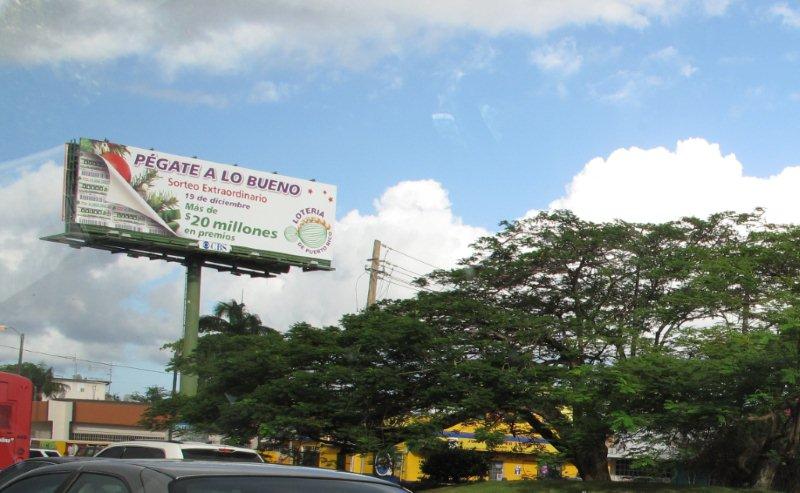
Amidst the heavy traffic, the lure of the $20m lottery
Everywhere in San Juan, one sees all kinds of festive decorations, even along highways. The taxi driver enthused, "Parties! Drinks! Parties! Drinks!" and then let out a full throaty laugh. That cheered him up in the dense traffic. The 4-lane highway #21 was heavily congested in both directions, between Guaynabo and Isla Verde at peak hours. Crawling traffic only. My colleague told me about a car jacking incident when a 16-year son of his friend, driving in a Lexus, was killed. That spooked me and has put paid to my plan of seeing the city centre at night.

One of the 3 buildings at City View Plaza, San Juan
The Puerto Rico office is located in City View Plaza at Guaynabo where a multitude of American global IT companies have set up office. All the creature comforts are there, and more, except tea. Inside it's all glass and chrome, fancy furniture and fittings, plus all the mod cons that one needs. It's in stark contrast to the basic working conditions at Nassau. 

The other day, a band appeared in the office playing some kind of festive music. They received a lukewarm welcome, as most people were glued to their seats continuing with their work. 

Festive cheers at the San Juan office
Near the office complex, there are a number of fast food joints. A chicken dish with rice and a drink is $6.99. Plantains are $1 extra per portion. You order the food from the cashier and fetch it from the counter where the dish is assembled. The food comes on a polystyrene plate with plastic knife and fork. It's sustenance, but better than Burger King or MacDonald's. One of the things about travelling is that it forces me to adapt, including eating things that I normally would eschew at home. 

Alas, on this trip, my experiences of San Juan and her people were limited to the trips between the airport, hotel, and the office. But this city has a lot more to offer than Nassau, and perhaps on another trip, I will visit the old city and explore a bit of Puerto Rico. 

And a word about the hotel. This is a green hotel. The water comes in a trickle. There is a car charging point next to the hotel, but no one seemed to be using it. I did not notice a single electric car during my daily commute. Such green bumpkin taken to the extreme. 
Views from the office at Guaynabo, San Juan.
Endless miles of highways.

Aerial view of San Juan, Puerto Rico

View from the hotel on the Isla Verda.
More highways.

Wednesday, 5 December 2012

En route to Puerto Rico

The spanking new check in hall at Lynden Pindling
international airport, Nassau
It's a pleasant surprise to step foot in the brand new terminal at Lynden Pindling International airport, Nassau. Such an improvement to the old terminal that serves presumably flights from other parts of the world. This new terminal serves US departures only and is staffed by US Immigration officials. It's the first time at departure that an immigration official asked me if the luggage showing on the screen belonged to me. There was the usual finger print taking, four fingers of the right hand, followed by the right thumb, then four fingers of the left hand, followed by the left thumb. The big surprise is the courtesy accorded to the travellers by the officials. 
The Embraer 145 flown by American Eagle on
short haul from Nassau to Miami

The flight was late arriving from Miami. Since I had bad experience flying with American Airlines, I was slightly concerned that the delay could result in me being separated from my luggage on arrival at San Juan, Puerto Rico.

Miami International Airport looks the piece. It is totally different from the one I remembered when I last set foot in Miami in the late 80s. The D terminal is spacious, airy, and gives the travellers a sense of calm. The signposting is first class. The sky train that whisked travellers from the arrival gates to the departure gates was fast and efficient. Everything worked. 

Sashimi counter at Miami International Airport
It was a huge relief to find some decent food again at MIA. The sashimi was delicious. No more rice and peas or plantains. The positions of the eateries are so well signposted, it was easy to decide if one had the time to get to a restaurant of choice, have something to eat, and then head for the departure gate. 

The 757 to PR was full. The flight attendant, a tad impatient, instructed the passengers that if they wanted to take off, they had better take their seats! No please, just straight to the point. It was chaotic inside the economy cabin because the overhead lockers were full and people had to search for a space to store their hand luggage. I noted that on entering the aircraft, the two women ahead of me dropped their luggage in the overhead lockers at the business class cabin and then proceeded to saunter down the aisle to the economy cabin. The big guy who sat next to me spent the whole journey munching non stop M&Ms and an assortment of sweets.
Approaching San Juan, Puerto Rico

It was raining at Puerto Rico. Exiting for baggage reclaim was a bit hairy because I must have picked up another route that no one used. I passed through many deserted departure gates, all on my own. And then at the baggage hall, it was pure guess as to which belt the baggage would be presented. (More in another blog when I discovered that the TSA002 lock in my luggage had been forced open).

Then, another pleasant surprise! A ground transportation official gave me a piece of official documentation showing me the taxi fare to the hotel. The taxi driver charged exactly that amount. The taxi was clean and tidy, unlike most of the taxis at Nassau Bahamas. Some of the taxis in Nassau are literally falling to pieces, and that is not an exaggeration.
The hotel at Isla Verde, with view of the ocean (just about)
And fInally to the last piece of surprise. The hotel has an Asian restaurant and served one of the most succulent steam garoupa, ever.

For now, it is back to a thriving city, and a respite to take stock of my Bahamian experience that turned out to be an assault on my sensibilities.