Sunday, 24 August 2014

São Paulo Series - Out and about in the safe areas

Is São Paulo a safe place? Second hand information came from a colleague who was robbed ten times, two of those incidents involved his car. Direct advice came from a female colleague: she has two purses with her at all times, one for surrendering to robbers and one as back up. Before the World Cup 2014, authorities in São Paulo issued a warning to visitors: "Do no react, scream or argue", the pamphlet says, according to Estadao de Sao Paulo, a local newspaper. Failing to heed the advice may result in robbery leading to cold-blooded murder. Furthermore, visitors are advised not to flaunt flashy items such as jewelry or watches, and to be vigilant at all times. With trepidation, therefore, I visited only a few safe places thus far.


News kiosk, Avenida Paulista

The Avenida Paulista has a number of news kiosks, selling newspapers, journals, books, cold drinks and the occasional tourist tack. But no English newspapers whatsoever. Daily diet of English news is restricted to CNN (a very USA-centric view of the world) and of course the internet.


A market of fakes, Avenida Paulista 

Of all the places I was least expecting a fake market at São Paulo. Here it is: an entire floor of market stalls selling fakes: watches, handbags, electronic equipment, all manned by Chinese. I almost felt ashamed that the Chinese peddle fakes all the way from factories in China to a city where people are robbed for their perceived high value items.

The Village, Augusta Avenue

The Village is a quaint shopping arcade with a collection of small shops. I was expecting some interesting home grown merchandise but nothing of the sort. A wasted opportunity. But maybe there isn't a demand for the kind of merchandise that I was looking for. 

Bikes for hire, Jardins area

I came across this bank of bikes in the Jardins area: a middle class area with high rise buildings guarded by security fences and gates. Judging from the availability, the demand for such bikes on the day was low.

Street art

São Paulo has a vibrant culture of street art. Even a closing down sales notice on the shop window is art.


Mural, Rua Haddock Lobo

Due to safety concerns, I have not been able to photograph murals that I see on the way to work. And there are some pretty spectacular pieces, including a series on the pillars of a flyover. This one is along an expanse of wall about 4 metres long, and depicts what I consider to be a fairy tale picture of a princess and paradise.  

Children's hairdressing salon

Not far from the hotel is this hair dressing salon for children. It has one of the most interesting designs that I have ever seen anywhere. I almost wished that I could be sitting on one of those chairs, admiring the decoration.


Any suggestion for a caption?

What a witty mural! And I was taught by my colleagues the significance of number 10 in the Brazilian football team. One colleague needed to buy the Brazilian national team's T-shirts for his sons and ended up paying 120 BRL for each - apparently before Brazil lost, the T-shirts were four times the price.


Parque Tenente Siquerie Campos 

The São Paulo Free Walking Tour took us to this park right in the city centre, which Rafa the guide described as a mini Amazon jungle. It's a short walk from the Museum of Art on Av. Paulista, and well worth a visit to get away from the hustle and bustle of city life. 

Graffiti, Avenida Paulista


Graffiti, underpass of Avenida Paulista

Graffiti and murals are such a large part of the day-to-day scene in São Paulo. The guide warned: do not venture to the underpass to take pictures of the murals! It is not safe!


Street vendors, Paulista Avenue

At the weekend, the Avenida Paulista is lined with street vendors, mostly selling the same things: jewelry, dream catchers, scarves. There must be some large warehouses somewhere, selling the same things to hundreds if not thousands of street traders. As I do not speak Portuguese, I did not attempt to inquire the price of any items on display.


Police, Av. Paulista 

There is a heavy police presence in the city centre of São Paulo. They all carry guns and wear flak jackets. I am not sure if they are there for deterrence or protection, or both. They bear evidence to the fact that São Paulo is not a safe place at all.


Love Locks

 The only few love locks that I saw at São Paulo. I wish there were more.


Street entertainer, Sao Paulo


The Big Ears, Sao Paulo

These telephone booths are colourful and attractive. Most of them have been sprayed with graffiti. I hardly saw anyone using them, since most Brazilians on the streets of São Paulo seem to have a mobile phone.


Everyday life


Everyday life


A seedy side of city life


Are they fakes?

I end this blog with this question: where are all the friendly people in São Paulo? Will I get to meet them? 

Sunday, 17 August 2014

São Paulo Series - Museum of Art

The São Paulo Museum of Art stands proudly and squarely on the Paulista Avenue, 8 metres above ground, supported by four pillars and connected by two huge concrete beams. Between the pillars and the beams, the huge space is used on Sundays by market stalls, and on a Saturday, it is a free space for citizens and tourists. It is such a clever and unusual design and such an unmistakable landmark.


The Sao Paulo Museum of Art, Av. Paulista

The internet describes this museum as holding the finest collection of European art in Latin America and indeed in southern hemisphere. So it came as a disappointment that it does not compare anywhere near the likes of Prado in Madrid or the Hermitage in St Peterburg. Still, it was a nice place to spend a few hours under cover on a Saturday. Today, the temperature was 20C but it felt more like 12C. 


The entrance fee is 15 BRL and all visitors have to open their bags for inspection at the security check point. Any bottled water has to be deposited at the cloakroom located at ground level near the entrance to the building. The security guard stuck a label with a number to my bottle of water and stuck another label with the same number to the back of my entry ticket and sent me off to the gallery. It was the first time that I experienced a ban of bottled water from an art museum.

Living rough, outside Sao Paulo Museum of Art

I have been struck by the visibility of makeshift shelters at São Paulo. Underneath the museum, there were people lying on the ground entirely covered by blankets. At one corner of the building there were two tents with signs of being lived in. São Paulo is such an expensive city, even by European standards, little wonder that signs of poverty are so rampant right in the city centre, on the main thoroughfare of the city. Where I stay, in the Jardins area, there are plush apartments behind security gates, with lush lawns, palm trees, and security guards in flak jackets.

Despite the disappointment of such a small collection, there are a few pieces that brought a lot of pleasure to me. Here they are, in no particular order.


Degas's Four Ballerinas on Stage. Such grace and elegance.


Renoir's Girl with a bunch of Spikes


Massuoli's Sleeping Diana - I could almost hear her breathing


Ingres's The Virgin of the Blue Veil - a mix of sensuality and serenity


Drouais's Duke of Berry and Count of Provence as Children - 

who would have thought they were boys?

In the basement area there was a photography exhibition and I found a lot of photos that I like. I wish I had the skill and the eye to take such photos. 

The X shaped staircase in the basement


Workers toiling to build Brasilia


Two boys having fun with their bikes 

Sunday, 10 August 2014

Sao Paulo Series - The faces of Sao Paolo

What a cultural shock to come face to face with a city so vibrant and yet so crumbling in her infrastructure. 

On arrival at Terminal 1 at the São Paulo–Guarulhos International Airport, it was evident that the terminal facilities were dated and tired. Fortunately my plane landed at 05:20 hours and was spared the long queue at immigration. But the luggage reclaim area was small and chaotic. I made a mental note to myself that patience is a virtue in this country since the words organization and efficiency are not common in everyday life.

After experimenting with a hotel near the office and decided that the facilities in the area were limited and the food at the restaurants nearby was dire, I've moved to a hotel in the Paulista area. The place is at best 3* but its location is a redeeming feature. Other tourists on Tripadvisor rate this hotel 4.6 out of 5 but they must have a different reference point. Cost of living is high in São Paulo, and 4* hotels are way above £100 per night. It's a case of living within one's means.

View from the hotel window

A few of us joined the São Paulo free walking tour. It was a huge group. Of course it was not free because the tour guide set expectations for tips: 15 to 20 BRL. That was an interesting way of being introduced to the city, far better than riding an open top bus and listening to recorded material. The tour focused on the landmarks of the city, but here, I want to capture the everyday life of São Paulo, seen through my own eyes.

Street art near Luz subway station

There is so much graffiti in São Paulo that street art is in itself worthy of a separate blog. It's a pity that street art has adopted a global flavour in characterization and subject matter and losing the local context. Look at this one: I did not see people in São Paulo dressed like this.

Stalls near Republic subway station 

Street vendors are rife in the city. Some sell from stalls erected by the municipality. Some simply sell from the pavement. It is common knowledge that there are politics, violence and corruption in the way street markets are organized  in Latin America. For those selling a few bits and pieces from the pavement, it is pretty obvious that they are trying to eke out a living. Officially, the city of São Paulo is home to 11 million residents. According to statistics, 35% live in extreme poverty and 27% live in mid-level poverty (both defined in terms of multiples of the minimum wage). 

Street vendor

Street vendor with just a few pieces

Homeless people sleeping rough near the Cathedral

Demonstration outside City Hall by homeless people

Away from rampant social deprivation, São Paulo was alive with music and people out on a Saturday afternoon enjoying themselves. In almost every public square, there were musicians and dancers playing for onlookers and tourists.

Street entertainment

Another aspect of life that struck me is the proliferation of juice bars in the city. The mangoes and the papayas are so sweet in this country - they are almost like nectar. Other tropical fruits are also available: guavas, passion fruit, watermelons: they are so refreshing for breakfast.

One of the many juice bars

Fruit stall at the municipal market

Crates and crates of oranges at the fruit market

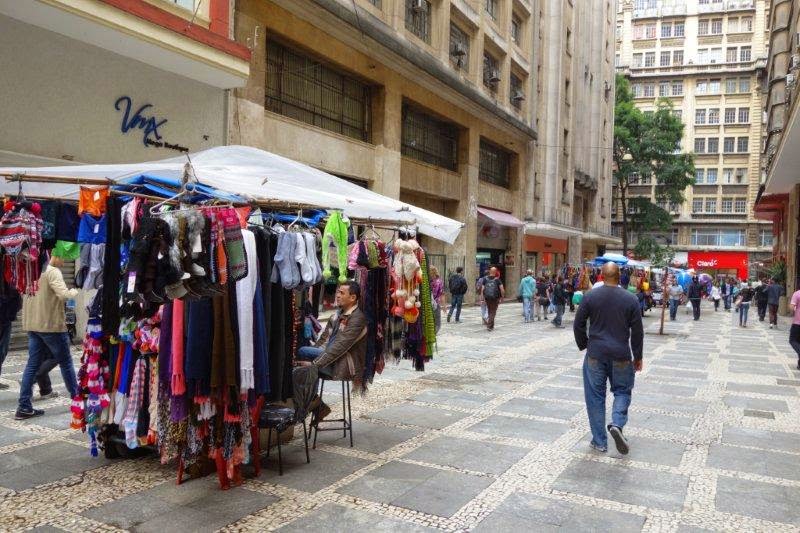
Talking about shopping in São Paulo, I'd only seen the budget end of shops. The merchandise on sale are rather poor in quality. Conspicuous consumption is absent in this city. I passed a street of local shops selling everything under the sun; even from a distance it can be said that price rather than quality is the primary consideration.


One of the shopping alleys that sell fake goods


Municipal market, thronging with tourists


Local bazaar

To end on a more positive note, there are sides of São Paulo that are much like any other big city: the business and financial centre that is flush with money, the traffic jam, the parts that the ordinary people live, and the occasional subway station in pristine condition.

Gleaming office buildings at Paulista Avenue

Sao Paulo's own stretch limousine


A brand new subway station

Everyday life 


Our tour guide, the one and only one Rafa

And to end this short blog, as my next free walk beckons, I am posting a photo of Rafa, who entertained us with his funny and sharp introduction to the old town of São Paulo. Bravo to this young man who has hit on an excellent business model: Free Walking Tour, appealing to the self regulation of tourists who are free to contribute whatever they like. And since Rafa does such a good job, most people could not deny him a decent tip


Friday, 1 August 2014

Chartwell, Kent

Chartwell, the home of Winston Churchill

We visited Chartwell because this was the home of Winston Churchill until his death. It has a wonderful collection of memorabilia connected with Churchill, including a medals room and a robes room. For a prime minister from a noble family and a towering political figure in the 20th century, Chartwell is rather modestly furnished. However, the house has a spectacular views across the Weald of Kent, which perhaps compensate for a house that has no great architectural merit.

Uncharacteristically for the National Trust, visitors are not allowed to take photographs inside the house. 


The view from the drawing room, Chartwell


Chartwell seen from the landscaped gardens 

The Studio that displays a collection of Churchill's paintings

Much is made of Churchill's passion and love of painting. But his output, though significant in volume, was nothing special. His ability as an artist is dwarfed by his literary achievement of winning the Nobel prize for literature in 1953.

Whitstable Oyster Festival

What is it about an oyster festival that took us 100 miles to this seaside town in north east Kent? Strangely enough, not just for the oysters but also a part of England that we seldom visit. 

Whitstable is famous for its oysters and its maritime heritage is celebrated during the annual oyster festival in July. It is a week long event, with carnivals, a food festival, and even a fireworks finale. But we deliberately missed the Food Festival over the weekend to stay away from the crowd; nothing is worse than circling around a car park waiting for an empty place. But even during the week, with the school out, there were many families descending on Whitstable to take advantage of an outing to the seaside on a hot summer day. 

Whitstable Harbour

The Whitstable Harbour is still a working harbour, flanked on one side by what is euphemistically called a shopping village, with all sorts of  independent retailers selling hats, kites, trinkets, summer clothing, candles, gifts, etc. Surprisingly, there seemed to be an absence of sea gulls swooping in and out of the harbour, probably because there were no fish being landed at the time. 


Breakwater at Whitstable Beach

Whitstable Beach

The Whitstable beach is a long stretch of shingle/sand beach where families sun bathed and a few took the boat out. I could see that a lot of sun bathers were perfectly bronzed and some already showing wizened skin. It does not cease to amaze me how a nation not used to the sun has so much tolerance for the fierce sun rays on a blazing hot summer day.

In the distance is a huge wind farm project on the Kentish Flats, the wind turbines together forming the biggest wind farm in the UK. Is this an eyesore or a thing of beauty? Already, the oyster farmers claim that wind farms attract star fish that eat oysters which eventually will wipe out the oyster industry and damage the tourist industry.

A bed of oyster shells

Something I learned on this trip: that empty oyster shells are harvested for baby oysters in their larval stage to attach to, so that they can settle down and go about the business of growing. Why pieces of shell? They are necessary to keep the baby oysters from being enveloped by the muddy bottom of the sea floor, which kills them. In places where oyster populations have fallen, empty oyster shells help to restore oyster populations.

Beach hut along Tankerton Slopes, Whitstable

Another sight I came to see are the beach huts. These wooden constructions, often painted in bright jazzy colours, and measuring no more than 10 ft square, are changing hands as much as £20,000+. A peep into the inside of these huts reveal limited furnishings: some shelves for storage, some folded deck chairs, a folded table, maybe a kayak; so the price that these small units command is probably related to the romantic notion that life is a beach: the seaside, the sun, the beers, and a well developed tan.

Knitted pram, Whitstable High Street

Knitted bicycle, Whitstable High Street

The Whitstable high street is lined by all sorts of independent retailers, including a mini market that sells almost everything under the sun. Most of the window dressings were uninspired, but now and then there was a spot of humour. Here, someone had knitted out a pram and a bike, which I found rather amusing.

Wheelers Oyster Bar, Whitstable

Sea bass, Whitstable Oyster Bar, probably the best fish dish

It is only fitting to close this blog by writing a few words about the Wheelers Oyster Bar. This tiny restaurant, famous for its take-away and eat-in sea food, offers the most sublime sea food dishes. It is an unassuming place, rather crowded, but with top-notch sea food that it serves up, it matters not whether there is table cloth,waitresses in uniform, or that one has to pay cash. I also had the most delicious battered oysters, something I have not eaten since I was a child. They truly beat raw oysters, but then we all like food that we grew up with: and as a Chinese, I grew up with cooked rather than raw food.