Monday, 3 November 2014

Athens Series - Benaki Museum

There are a number of noteworthy museums at Athens that I was determined not to miss. The trick however is that strolling among the museum exhibits is exhausting, particularly in the rarefied atmosphere inside the museum. I remember the time when I had to lie down for a while at the Prado Museum just from sheer exhaustion. So much to see, so little time, and not much fresh air.

The Benaki Museum is one of those private museums established and endowed by a fabulously wealthy family, in this case the Benakis. Over 3 floors, the museum showcased gold, funerary steles, arms, wood carvings, ceramics, pottery, glasswork and textiles focusing mainly on Greece through all ages of Greek culture and history. It is a museum rich with variety but lacking in statement pieces. However, the complete freedom of movement within the  museum where visitors are expected to respect the place and the objects on display was entirely refreshing. There was not a single attendant admonishing visitors not to do this or that.

The neoclassical entrance to Benaki Museum, Athens

Foyer, Benaki Museum

One of the exhibition rooms. Notice the folk costumes, part of a huge collection

Part of an extensive collection of gold jewelry

Incense burners and religious objects

One of the fabulous altarpieces

A watercolour of the Acropolis

Byzantine art: an icon of Christ. Note the skin colour.
What I missed was a good audio guide to learn more about the exhibits. The museum assumes that the descriptions are enough, but they are not because I for one would like to learn more about this vast collection amassed over the years and spanning thousands of centuries from pre-historic time to the 20th century.

Athens series - The Acropolis

There is so much material on the Acropolis on the internet that an unschooled person like me in ancient Greek history can add little value to. We came to Athens because it was only less than four hours away from London and it is the seat of the ancient Greek civilization that counts Aristotle and Plato as their pre-eminent thinkers.

We entered the Arcopolis from the south slope, near the Acropolis Museum. It was a meandering climb, often along unpaved paths. Ruins were littered on the way and we came across a number of Japanese and Chinese tourists taking turns to pose among the ruins. The price of a unified ticket is €12, which includes entry to other major monuments of Ancient Athens (the Agora, the Roman forum, the Temple of Olympian Zeus, the Kerameikos and the theatre of Dionysos). We only managed to use two of the stubs on the ticket so cannot attest to its value.

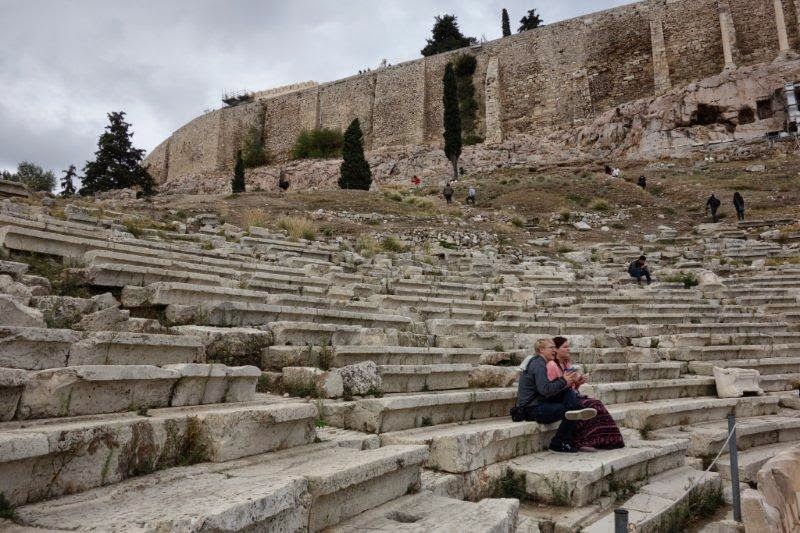
Present day remains of the remains of the Theatre of Dionysos
On the southwest slope lies the beautifully restored Odeon of Herodes Atticus. This is a stunning piece of architecture: the audience stand and the stage were restored using pentelic marble (the material used for many Greek statues seen in various museums at Athens). One can imagine the setting and atmosphere when the theatre plays host to internationally acclaimed artists and orchestras.


The magnificent Odean of Herodes Atticus

And now onto the Acropolis. We were not expecting a huge crowd since it was already autumn, past the peak season. On approaching the Propylaea, the monumental gateway to the Acropolis of Athens, we were slightly overwhelmed by the hustle and bustle. It was windy and chilly on the day, thus adding to the noise (in my head). The gateway is flanked by massive pentelic marble columns and in their unprotected state, caused the stewards to keep barking orders to visitors not to touch them. Some protection would have removed all the aggravation.

The Propulaea, entrance to the Acropolis
Once upon the Acropolis, two large monuments dominated the view. I was actually slightly underwhelmed by the Parthenon, probably the film that I saw about this monument at the Acropolis Museum gave it the grandeur that it has lost due to the massive cranes situated inside the building. It took the Greeks 9 years to build this in 4th century BC, but it has taken the modern day Greeks many years to restore it, the restoration having started since 1975 and is still on-going. 


The Parthenon
To the north side of the Parthenon lies the Erectheum, an ancient temple dedicated to Athena and Poseidon. I was fascinated to learn that there were six original Caryatids: five have been moved to the Acropolis Museum for exhibition and replaced in situ by exact replicas and the sixth was removed by Lord Elgin and is now exhibited at the British Museum in London. When visiting the museums in Athens, one was constantly reminded of the repatriation of ancient monuments to Greece from Germany and France, but the issue of the so-called Elgin marbles misappropriated from Greece remains contentious. I do not believe that any nation has the right to remove national treasures from other countries, with or without the permission of the ruling government at the time.

The Erectheum from the south, with the Porch of the Caryatids on the east side

The view from the Acropolis was breathtaking. In the distance is Mount Lycabettus, with panoramic view of Athens. Unfortunately we did not have time to visit this place, let alone the funicular railway that would have taken us to the top.
Mount Lycabettus from The Acropolis

View of the Acropolis from the south slope
On the way down from the Acropolis, we used the well trodden path on the north slope, and it was a much easier trip. 

Sunday, 5 October 2014

São Paulo Series - Instituto Cultural Tomie Ohtake

The art tour of São Paulo includes the Instituto Cultural Tomie Ohtake, a building named after a Japanese naturalized Brazilian artist. 

The taxi driver knew the place; I did not have to present him with the piece of paper on which the address was written. This is quite unusual because most taxi drivers do not quite grasp my pronunciation of various places in Portuguese and have to rely on the written word.

The unmistakable shape of Instituto Tomie Ohtake
As soon as I saw the building, I was captivated by the shape and the colours. It is a statement piece and it created an expectation of the place. The reception area is large, with a few art shops on one side and temporary exhibitions on the other side. I love the space and the fact that it was not thronged with people. There were some beautiful hand-made jewelry on sale but they were quite expensive compared to UK prices. 
The reception area

The exhibitions were another matter. The curator has made sure that there is English translation for all the exhibits, which was most unusual in Brazil since English is not much spoken. Still, not much appealed to me. 

Luiz Zerbini "The First Mass"
"The First Mass" struck me as a surreal painting. What is the meaning of the coiled snake on the head of the man dressed as a priest? What is the meaning of his tied hands? What is the meaning of red breasts on a black woman? But the colourful landscape and the exotic vegetation drew me to it. 

Landseer's Black Punishment at Rio de Janeiro
The painting that provoked the deepest thought was Charles Landseer's Black Punishment at Rio de Janeiro. Of course most of us read about the brutal way in which slaves were treated by their masters but seeing the punishment in such a graphical way was a unpleasant confrontation with the colonial past. There was a narrative to explain why Brazilians were considered to be "lazy": to the slaves, back breaking work at the sugar plantations represented the oppression of their colonial masters. 

There was a common theme to the visual art on exhibition: the colonial past and the hardship endured.
Modesto Broco's Manioc Mill
Sidnei Amaral's Discomfort
On leaving the Institute, I realized that Salvodore Dali would be coming to this place at a time when I would have left Brazil.... Timing is everything.

São Paulo Series - Street Art

Street art is a phenomenon at São Paulo and it adds colour to daily life. Everywhere in the city where there is a gap in the wall, it is likely that some artists will have claimed the space and drew on it. 

I have always wanted to see street art in places where there are a concentration of different styles and subject matter. Alas, due to concern for personal safety I only dared to go to places where there are likely to be other visitors. So I headed for Beco do Batman (or Batman Alley). And I was not disappointed.

There are so many interesting pieces; no amount of blogs will do them justice. Here, I have picked the ones that appeal to me personally. No narrative is necessary.


Beco do Batman
Utterly charming - a house with murals

Sunday, 28 September 2014

São Paulo Series - Food, what food?

I never thought I had enough material to write a short blog on food at São Paulo. Most food at Brazil seem to come laden with butter and cheese. For me, learning the words "no butter, no cheese" in Portuguese has become an important survival skill if I were to eat anything suitable for my palate. In fact it is easier to pass off my dislike for butter and cheese as an allergy rather than appearing as a fussy eater. Another thing about Brazilian food: the high salt content, in fish, in meat, and especially in their national fish the feijoada.

My first introduction to churrascaria was at Fogo de Chão, an upscale Brazilian steakhouse. The price per person was BRL 130 (£43) plus 10% service charge (not optional). It was an overrated experience, since there was absolutely nothing special about the meat. The fun bit was flipping the chip from green to red when I needed more time to chew the rather tough meat. The only saving grace was the salad counter. But one does not visit a steakhouse to enjoy the salad counter. The diners at the next table had a whale of a time: they seemed to have the stomach of a whale and were stuffing themselves full at this all-you-can-eat joint.

Then one day a colleague took us to a local restaurant near the Portuguesa-Tietê station where food was sold by weight, and it changed my view of the Brazilian steakhouse. For a mere 15 BRL (£3), I had a plate of tasty chicken, fish, a few pieces of sausages, and some hot vegetables. My plate was not big enough for the grilled meats so I passed on the opportunity.


A small churrascaria near the office

Brazil of course has her own street food. These are fried bar snacks, to be paired with ice cold beer or in my case, suco de manga. There are pastéis - deep-friend parcels of crisp pastry with melting cheese, or minced beef, or creamy palm heart, or crunchy batons of manioc, bolinhos ("little balls") often made with salt cod. My favourite is the coxinha ("little thigh") with shredded chicken and potato pureed, shaped like a (very voluptuous) thigh and covered in golden breadcrumbs. But unavoidably, some of them came with cheese, which I had to diligently scrape off.


Coxhina

Perhaps, more blessing than curse, the restaurant at the hotel offered some decent fish dishes. After an unpleasant saga with the credit card (being compromised), I became more or less hotel bound while waiting for the issue of a new card to arrive from Spain. So to hotel food I turned, and it was a creditable experience, thank goodness.


Robalo with grilled vegetables


Halibut with couscous and deep fried shredded onions


Salmon with leeks. Salmon is expensive in Brazil

And now to the best local meal I had: a rather expensive meal at a restaurant called Amadeus at the Jardins area. The average age of the diners at this restaurant was at least 50, an indication that this was not the haunt for the hip young generation. The cover charge was BRL19 which included, if you asked for it, a small basket of bread and bread sticks. The service was impeccable.


Fish curry with banana and palm puree


A trio of coconut dessert, Yummy.

Another decent meal I had was at the self service restaurant at the Museum of Art (MASP). There was a good selection of salads, cooked meats, and desserts. This was my lunch, and it included some kind of feijoada (a stew of black beans with beef and pork). The price was BRL44 (£12) for a buffet, very reasonable at the Paulista area. I distinctly remember that the chicken was tender, unlike the rock hard stuff that is usually served at the canteen or some other eateries.


To close this blog, the best meal during this series of travel to Brazil was with the national carrier British airways. It is ironic that when I have become tired of eating food for sustenance that it was the airline that offered something visually pleasing and tasty. Three cheers to BA. 


Sea food salad on board a flight from LHR to GRU

I am not expecting to have more material to write about food in Brazil. Disappointingly for a dessert lover, I have found the Brazilian desserts to be too sugary and have learnt to avoid them.

Friday, 26 September 2014

São Paulo Series - Out and About

It is a pity that I do not have much time to explore São Paulo. In any case, I am concerned for personal safety and this alone restricts my movement.

At the weekend, the Avenida Paulista was packed with tourists, and with them came the street traders who sold mostly from the pavement. There were dozens of these traders selling bracelets, beads, earrings, dream catchers, wool hats, scarves; they were all much the same to me; individuality sorely missing from the merchandise.


Street vendors along Av. Paulista

Underneath the Museum of Art (MASP) along Av. Paulista, every Sunday there is an "antiques" market. I put antiques in parenthesis because a lot of goods sold at these stalls are more flea market items than antiques. I noticed that some merchants have on line credit card machines, which indicate their transaction value. On the day I noticed a merchant selling a collection of ivory carvings of Chinese origin. The carvings have yellowed with age, but of course if it is imitation ivory, then the yellowing could be due to tea stains. Well aware of the controversy surrounding ivory, I gave the beautifully carved ivory pieces a wide berth. There were many stallholders selling jewelry, most of them dainty little items, nothing spectacular.


The Antiques Market at MASP, Av. Paulista

There was a hive of activity along Av. Paulista. Tourists mingled with the locals, little dogs snarling or wagging their tails at other little dogs. Lots of people were out there to make a living.  In the midst of these, spare a thought for those who live rough along this famous avenue lined with modern offices and banks.

Not sure the purpose of the demonstration

A musician at work

Elsewhere, in the residential area of Rua Haddock Lobo where apartments are behind two tiers of security gates, and not too far from the premier shopping Rua Oscar Freire, I saw this upmarket boutique advertising swim wear as "Winter Sale". The irony was lost on me because the seasons seem to be jumbled up in the southern hemisphere.


And now, to something closer to my heart: architecture and street art. The mundane mixed with the less ordinary, the humorous mixed with the charming, and through these the people of São Paulo reveal a part of their soul.

A mural on a building


I call this My Little Princess's Dream


Interesting use of the palette


A small building sitting on a gold mine in this prime residential area


Mural outside a house in the Vila Nova Conceição area