Friday, 13 June 2014

Hamburg Series - Minitur Wunderland

The Miniatur Wunderland is truly a wonderful place. Who would have thought that a construction of miniatures can be so fascinating and enjoyable!
Minitur Wunderland, Hamburg
Getting to the exhibition took us to the Speicherstadt area, which is the historical warehouse district along the River Elbe in the heart of Hamburg. The red brick warehouses themselves are beautiful architecture and worth a visit.

The Wunderland website has warned of long queues. To avoid the queues, I'd obtained a "fast track" voucher, which turned out not to be necessary on the day, since it was a weekday and not a weekend. The young girl at the ticket counter was extremely friendly, and we could tell that it is a different kind of enterprise to those that employ middle-aged women, often fierce-looking and stoical, to man the ticket sales.

There is so much to see! Everything: the design, layout, handicraft, electronics, is first class. Unexpectedly, there is a lot of humour too in the layout, which makes it extra enjoyable.

Here are just some of my favourites.


A building on fire. There is a button which when pressed, lights up the flames and sets the fire rescue in motion. The attention to detail is incredible.
Las Vegas at night.
A derailed train and a helicopter to the rescue. 
There are a lot of accidents on the various layouts: car accidents, motor cycle accidents, derailments, which make them statistically significant.
A flower power festival. It amused me to see the caravan and the VW van covered in flowers, not forgetting the two VW beetles one of which is pink and painted with flowers. Whoever made this miniature set had a powerful imagination of what went on in the 1960s.
A bike race. Or maybe it was Tour de France? At the bend, there is an accident and you can almost hear the arguments going on.
I love these festival scenes although I have not been to one myself. It is utterly charming for the dancers to be dressed up as flowers and for a fast food stall to look like a toadstool. And hey, there is also a little dog in the middle of the ring!
And now, for a change, a snow scene. We learnt that the snow is made of very fine pieces of glasses, which makes the snow looks so life like. I particularly like the three figures who are pushing the truck up the hill.
More festival scenes. Life is a long series of festivals. Tents, people, action galore.
The Hamburg football station, during the day and at night. The story goes that the owners are supporters of the Hamburg football club so a model of the stadium has been made and the games played on the screen inside the stadium ensure that Hamburg wins every time.
We went behind the scenes and were treated to the secrets of the trade. Here, a bank of batteries await the vehicles for their regular recharge. Miniatur Wunderland has written their own software and most of the vehicles are run at random, which means that the spectators do not see the same thing over and over again.

Visiting the Minitur Wunderland is the highlight of the trip to Hamburg. I cannot think of anywhere else in the world that we have visited that offers so much fun.

Hamburg Series - Kunsthalle


This is an interesting art museum complex. Entrance is at the new wing - the Galerie de Gegenwart - where modern art is displayed. To reach the old masters and the 19th century paintings, one has to use an underground tunnel from the new wing, and this underground tunnel is not clearly signposted - quite unusual for the Germans.


The Schirrmacher/Hude red brick building that houses the old masters
Impressive landing leading to the grand hall 
where 19th C paintings are displayed
A grand exhibition room inside Kunsthalle Hamburger
There are so many treasures in this museum. Here are my favourites.

Repairing the nets by Max Liebermann
The harsh life of the womenfolk who repaired the fishing nets came through vividly in this painting: the inhospitable weather, the toil, and the look of yearning for a better life perhaps of the girl in the foreground.

The Arctic Sea by Caspar David Friedrich

Drifting clouds by Caspar David Friedrich
Iphigenia by Anselm Feuerbach
An unmistakable Rodin

Caspar David Friedrich's Wanderer Overlooking the Sea of Fog
Meister Bertram's altar masterpiece
It is quite easy to spend a whole day at Kunsthalle, with so many treasures to admire and explore. However, the entire museum is lacking in chairs so it was a struggle to be on one's feet anymore than 5 to 6 hours at a stretch.
The Cube, a very pleasant restaurant at Kunsthalle
Attached to the new wing is the Cube restaurant where some decent, modern food is being served. The shelves behind the bar are entirely decorated with Pommery champagne, and I have yet to figure out why a French champagne and not a German Sekt?

Tuesday, 3 June 2014

Japan Series - The Port of Nagoya Public Aquarium

I am fascinated by aquariums. The first one that grabbed my attention was the Oceanographic at Monaco, then the Aquarium Barcelona at Barcelona, Ocean Park at Hong Kong, Nausicaa Centre National de la Mer at Boulogne-sur-Mer France, Vancouver Aquarium at Vancouver, Sea World at San Diego, Osaka Aquarium at Osaka, and I realize that I have not even seen one of the top 10 biggest aquariums in the world!

It was not easy getting to the Nagoya Aquarium. From the Sakae subway station, I took the Meijo/Meiko Line Subway Line to Nagoyako Station but had to inquire because every second train on the Meijo Line operates on the Meiko Line runs to Negoyako Station. Not being able to read Japanese certainly did not help. A group of giggling young girls failed to convey to me the instruction until a Japanese woman who speaks English came to the rescue and told me "next, next train". 

The Port of Nagoya Public Aquarium

There are two buildings: the North Building contains one of the largest outdoor tanks in the world and is equipped with a stand that can seat up to 3000 spectators. Here, the audience is treated to dolphin performances. The shows are displayed on high vision screens, making it easy to see the details. Alas, I wasn't prepared to hang around for an hour for the next show, so I gave it a miss.

The stand for watching dolphin shows

The South Building starts off in the waters of Japan, journey through the deep seas where strange creatures live, pass through the equatorial seas with their colourful fish, and are treated to the sight of sea turtles, which have been successfully spawned in captivity, and penguins living comfortably in a habitat recreating the Antarctic environment.

Once inside the Aquarium (and it was a relief from the baking sun), I had a whale (sic) of a time. My all-time favourite was the sardine tornado, played to some exciting music that recorded the swoosh and the swish of a torrent of sardines. Young and old alike were mesmerized.

Tornado of sardines, Nagoya Acquarium

A ballerina of a jelly fish

My next favourite was the jelly fish. Such a graceful creature, floating in the tank like a carefree cloud in the blue sky. I watched the jelly fish danced for ages.

Corals, corals, corals

Japanese spider crab

A dolphin and its trainer


Beluga whales in a mock settingThe sky is just a canvas

A sea turtle


Japan Series - Nagoya

Nagoya - the castle, the Aquarium - those are the things that draw me to the city. On a Shinkansen Hikari, it only took between 85 and 107 minutes to get to Nagoya from Shin-Yokohama. Because inter city trains are so frequent, it is extremely convenient to travel around the major cities in Japan.
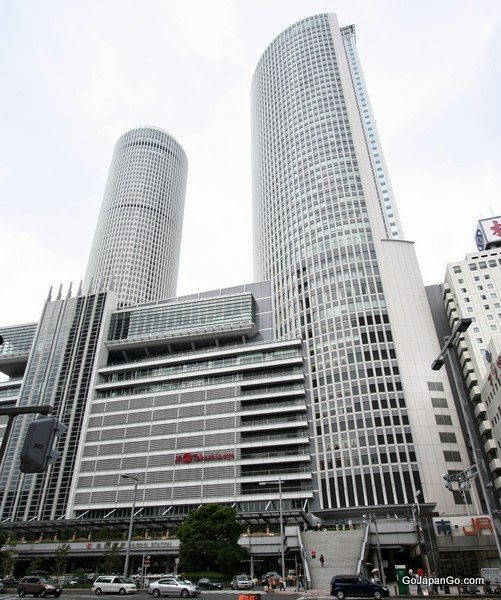
JR Station, Nagoya
The JR Station at Nagoya is located on the ground floor of the JR Central Towers - a massive structure that rises above the Nagoya Station. The building consists of a 245 metre tall Office Tower and a slightly shorter Hotel (Marriot) Tower. The lower floors house a Takashimaya department store and there are restaurants on the 12th and 13th floors. 
Observation Deck, 15th floor, Hotel Tower, JR Central Towers


Getting ready for a wedding ceremony
15th floor, Hotel Tower

Foyer, Marriot Hotel, Nagoya
What attracted me to the Marriot Hotel is its central location, in the middle of all the transport routes. The hotel has been modernized and blessed with a large retinue of staff, some 6 or 7 of them had positioned themselves at the reception area to welcome hotel guests. Unlike hotel staff who mill around hotel reception areas in Beijing, the staff in this hotel are actively engaged with their guests, bestowing on them warm and effusive welcomes. The concierge who helped me plan my visits was probably one of the best concierges I had come across in all my travels - humurous, knowledgeable and took the time to ask me the things that I like and consequently introduced me to a garden in Nagoya that I would otherwise had missed.
JR station at night
At night time, the JR station is no less busy than during the day. A noticeable difference was the number of young people hanging out in the area. Invariably these young people are well behaved - no sign of drunkenness, loud or rude behaviour. I noticed that young girls giggle a lot.
A garden area on 1st floor of JR Central Towers
A very pleasant surprise was to stumble across this oasis of greenery on the first floor of the JR Central Towers, near the escalators that connect to the subways. It was relatively quiet because of the heat - the Japanese do not like the sun: most women wear a hat or carry an umbrella to keep their complexion porcelain white. 
Beautiful orchids, Takashimaya department store
I took a picture of these beautiful orchids are the Takashimaya department store and was immediately admonished by a sales assistant. She made a sign of the cross with her two index fingers - a Japanese sign indicating "No". I don't understand why photography was forbidden but it was not my place to argue.


Bicycle racks, Naogya
In all the big cities, there are bicycle racks, all in good condition. I noticed in Yokohama that cycle lanes are marked out on the pavements rather than on the roads! I further noticed that cyclists were not required to wear helmets. Ho hum.


View of Nagoya at night from the Marriot Hotel
At night, Nagoya looks beguiling. I could not imagine that it was the target for two of the Bomber Command's attack during WWII and that nearly 15 sq km of the city was devastated during those attacks.

Japan Series - Kawagoe

What was it that drew me to Kawagoe? Well, it was a short hop and skip on the train: 30 minutes from Yokohama to Shinjuku, and then 60 minutes on the JR Kawagoe line from Shinjuku to Kawagoe. The Japanese train system is a breeze to use. 

The tourist literature declares Kawagoe to be a town with a long history, from the Edo period no less. There are many candy shops and sweet shops in the Kashiya Yokocho (Candy Shop Alley) and each shop has a unique method of producing those sweets. My sweet tooth aside, I needed to buy some crackers for a loved one. There is also the Kurazukuri Zone (the old storehouse zone) where the area is lined with buildings of traditional architecture (Kurazukuri) that takes the visitors back in time. Sounds interesting.

On arrival, a very friendly Japanese man (most Japanese in the service industry are noted for their friendliness) at the the Tourist Information Centre at the station  explained to me the routes and logistics of getting to the places that I wanted to see, including where to catch the loop bus and the the timetable for the bus. Everywhere I go, the Japanese have made me feel welcome.
Entrance to Kita-in Temple, Kawagoe
First stop was the Kita-in Temple. This temple possesses many cultural assets such as buildings that were relocated from the Edo Castle. More importantly the 27th head priest of the temple was trusted by Tokugawa Ieyasu and the temple became specially protected by the regime. Such was the close tie between religion and power.
500 Buddhas, Kita-in Temple, Kawagoe
Within the grounds of the Temple are 540 stone Buddhas that display all sorts of human emotions. According to legend, there is a warm body among these stone statues if you go there at night and touch them. How fascinating.

Snack shop, Kita-in Temple, Kawagoe
There were a few snack shops within the Temple ground. Most of them sold the local delicacy of roasted sweet potatoes. On the day I bought a stick of what appeared to be fish balls but they turned out to be some flour-based lumps that tasted of nothing but left a aftertaste of glue in my mouth.
Kawagoe Art Museum
Everywhere I go, I make a point of visiting the local Art Museum. But the Kawagoe Art Museum was a huge disappointment. The permanent exhibition was on one floor, with forgettable exhibits. No wonder the place was empty. I broke my own principle of avoiding places that are empty.
A display at the Kawagoe Museum
Kurazukuri Zone, Kawagoe, after most of the tourists were gone 
I had high hopes of the Kurazukuri Zone, but it turned out to be a tourist trap. I was attracted to the architectural detail of the roof with black plaster and learned that these buildings were resistant to fire because roof tiles were used. Only thirty or so of these buildings remain and most of the Kurazukuri were built after the Kawagoe Great Fire in 1893.
Candy Shop Alley, Kawagoe
The Candy Shop Alley was buzzing with tourists, all buying. Here, I encountered a Japanese trait that is unforgettable. I bought a bottle of cold water from a vending machine and forgot to pick up the change. A man ran after me to hand me back the change. This not the first time that things were handed back to me. At Narita airport, a young girl ran after me to return me my black leather jacket that I left behind in a toilet cubicle.
Unique selling point, Candy Shop Alley, Kawagoe
A home made refrigerator
Kimono-clad visitors, Kawagoe
The women were buying some
rather expensive lacquer hair accessories
A quiet corner, Kawagoe
All in all, it was a pleasant day out. Would I be taken by tourist literature again? You bet. Would I visit Kawagoe again? No.