Saturday, 28 March 2015

Nairobi Series - The tourist traps

In order to see all the tourist attractions in one day, I visited the elephant orphanage and the giraffe centre on the same day as the Nariobi National Park.

A colleague advised: go see the baby elephants in the evening, make an appointment to adopt an elephant. However, the hotel advised otherwise. Go between 11:00 am and 12 noon to see the feeding of the elephants. On arrival at the David Sheldrick Wildlife Trust, I was accompanied by a gun-toting female guard from the van to the animal centre. After paying a fee of 1000 Ksh, I entered the compound where the elephants were being fed and were playing around. There was a man talking on a microphone about the background of the elephant orphanage and introducing the elephants one by one. Most of them had fallen into a well after losing their mother. Such sad tales.

A baby elephant drinking from a container

Two baby elephants rolling in the mud

Baby elephants being fed with human breast milk formula
Next to the Giraffe Centre. At the centre, visitors were allowed to feed the giraffes pellets. During an information session, the staff informed visitors that feeding takes up most of the giraffe's day - up to 75% at certain times of the year. 

One of the giraffes in the Giraffe Centre

Up close and personal
I think I had a fair share of the animals and having rubbed shoulders with hoards of tourists at the elephant orphanage and the giraffe centre, I reflected on what I had learned coming into close contact with the elephants and the giraffes. Sadly, nothing much except that I covered all the tourists traps in one day.

Nairobi - A Day with Animals at Nairobi National Park

Everybody told me I should visit Nairobi National Park, a wildlife park within 7 km of the city, separated by an electric fence from the metropolis. So I duly did. 

The driver was 30 minutes late. By the time we arrived at the park, there was already a queue at the ticket office. In any case, the ticket office also opened late by more than 30 minutes. After enduring almost 45 minutes of waiting to purchase an entrance ticket, exacerbated by the excruciating inefficiency of a mixture of manual and computer processing methods, we finally made it into the park. At the ticket office, there was one man writing down on a piece of paper the purchase items: number of local visitors (the driver), number of foreign visitors (myself) and number of vehicles, which he then passed on to a woman who entered the information into a computer. The woman also demanded to see the identification papers again before the computer slowly churned out the tickets. At the entrance, the guards who examined the tickets decided that the ticket for the car was the wrong kind, so the driver collapsed the backseats of the van to pass it off as a small vehicle. What could have been a simple operation turned into a lengthy process that called for infinite patience.

There were more cars than animals on the day. It was a disappointing introduction to safaris. 

Nairobi National Park
Zebras grazing with human habitation in the background
The odd buffalo roaming the park
Impalas
Gazelles
The odd giraffe
A baboon surveying his territory
Zebras close up, against the Nairobi skyline
Tourists straining their eyes to see a lion's head
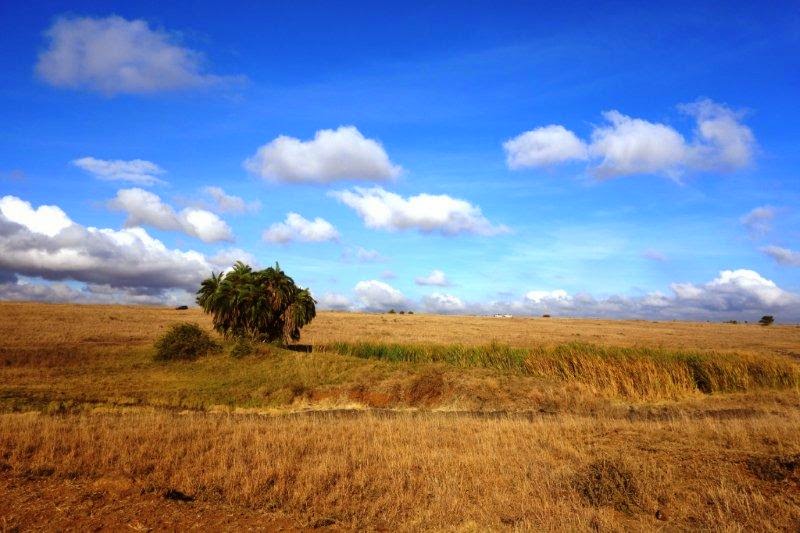
Peace and quiet at the park
I suppose it was luck whether I got to see all the animals including the lions at the park. Whilst waiting to purchase the entrance ticket, an English woman excitedly told me that she visits the park everyday to watch the lions at location 7, including her lunch breaks during the week. Such dedication. Later I saw her jeep parked at location 7 but nowhere were the lions to be seen.

Sunday, 15 March 2015

Nairobi Series - Jomo Kenyatta International Airport

Avoid this airport if you can.


The car was searched visually on entering airport. It was a meaningless activity because anything could be hidden inside the luggage. But it created a long queue, and jobs.

My flight was from terminal 1B but there is no drop off at 1B, only at the adjacent Terminal 1A. At one point I was walking on the road pushing the luggage trolley towards Terminal 1B with cars inches from me.

There was a long queue at the entrance to Terminal 1B. People were waiting to pass their luggage through security scanning. As I considered myself Priority I showed my boarding pass to the guard who allowed me to pass. At the conveyor belt, each passenger has to manhandle his or her own luggage on and off the belt. A passenger behind me had endless pieces of luggage which she tried to squeeze between mine. It was chaos. (Much like London Heathrow terminal 5 Priority check in).

The check in at British Airways was efficient. The check in desk explained that the BA lounge was a temporary one at gate 10. A permanent one has not been rebuilt since the fire in 2013.

Then immigration. Finger prints on exit!? That's a first. Then to gate 10, bypassing all the tourist tack. It was 22:00 and I was tired after a day's work, a 2-hour drive to the airport, and the hassle of getting myself to gate 10. At gate 10, there was a second security check on hand luggage. Absolutely no smiles. Immediately afterwards, BA mounted their own security check. Three security checks, surely this is overkill.

Into the BA lounge which was no more than a cafe circa 1970. The bottled water in the fridge was warm. There were some sandwiches and crisps, neither of which interested me. There were also alcoholic beverages including the local Tusker beer. The wifi was useless - I could not get on line. The wifi password was taped to a window and one needed a pair of binoculars to see it. Shame on BA. The chair arrangements in the lounge were such that free flow of foot traffic was not intended.

Four Englishmen same to sit beside me, swigging beer. They talked loudly and from their conversation, they were expatriates returning to UK for home leave.

A family came with two kids and one of them was screaming his head off, non stop. I wondered where his energy came from. Both parents made no attempt to stop the howling, maybe they too were tired out by the travelling, and the screaming.

Finally the boarding took place - no announcement, just the seasoned travellers getting up from their seats and walking to the departure gate. A woman called my name and gave me a ticket stub that showed that BA had upgraded me. 

Then back to civilization.

The thought of having to go through this again filled me with despair. It was a joyless experience.

Sunday, 8 March 2015

Nairobi Series - My daily dose of local news

Everyday I receive a local newspaper. It used to be the Standard, now it is Business Daily. The Standard is front to back local news and without local knowledge it is difficult to follow the politics. 


What else?
About the traffic congestion. It took 2 hours to travel the 18 km from hotel to the airport by car. What puzzled me was this: the traffic lights were working but the traffic was controlled by traffic police. Nothing moved. I asked the locals "Why are traffic lights ignored by traffic police?" The answer? Yes, you guessed it.


Drought threat
Reading about the drought threat made me feel guilty about leaving food on the plate. 


Serious academic matters
This advertisement on the ranking of University Nairobi in the world league caught my eye. On the left hand column you see the Africa ranking and on the right hand column the world rank. It's ironic to me that a ranking of 855 deserves a mention. 


The first piece of news when I arrived
"Who killed Muchai" greeted me when I arrived. The MP was murdered along with his driver and two body guards. 6 suspects were arrested and one suspect accused the police of torturing him for a confession.


From waste to art
Ultimately I prefer more good news and less bad news. I am tickled pink by this article on making art from old flip flops. Trouble is: I don't see a lot of flip flops being worn in Nairobi.

Nairobi Series - Living in a Bubble

Security (or lack thereof) is such an issue that I hardly ever venture out of the hotel. I am not even allowed to walk the 500 m from the hotel to the office. So be it. It's for my own safety. It's surreal to live my life in a bubble, cut off from the real world, unaware of the struggles of everyday life as told to me by the drivers taking me to and from the Jomo Kenyatta International Airport (JKIA)

Baggage reclaim at JKIA 

It is only fair that I feature the welcome sign at the JKIA, right next to baggage reclaim, after passport and visa.  It would be fair to say that there is probably one luggage cart chugging away between the aircraft and baggage reclaim. Despite my luggage being labelled Priority, the waiting time was 25 to 30 minutes. I count my blessings because unlike experiences at Chicago or Miami, the baggage was not tampered with or missing. Slowness is a way of life here. 

The hotel is almost like an oasis. This is a 5* hotel where heads of states on the Continent often meet. At the entrance to the hotel are security gates where cars are searched, much like the entrances to a lot of public buildings. Staff are well groomed and well mannered and would greet me by name. I am not used to such pampering and have determined not to get used to it because soon I will return to the real world where I have to do most things myself.

Hotel fountain at entrance

Hotel back garden

Manicured lawns and borders at hotel
Waiting for the car in the morning. The car is always late.
View from the hotel facing dual carriageway.
I sleep with ear plugs.
View of hotel at the back, away from traffic.
Is this life equivalent to living in a gated compound? A colleague, an expat, told me that he lives in a gated compound and his house is guarded 24x7 by two security guards. The expat economy is expressed in this simple formula: one expat = 5 local jobs (1 maid, 1 driver, 1 gardener, 2 security guards). His house has 2 levels; if there is a security alert, the second floor goes into lock down. A former prime minister lives within this gated environment and 5 identical Mercedes Benz cars are used on each outing. Also living in the same gated environment is an Indian billionaire who travels by helicopter. He was once kidnapped from his house within the compound. 

Away from the bubble, the landscape can be an eyesore. The fact that I was able to take photos from the car meant that traffic was not moving and it was possible to take a quick photo with my iPhone.
Passing through a part of Nairobi

Tracks of unused land, Nairobi
View from the office canteen

Sunday, 22 February 2015

Nairobi series - Nairobi National Museum

The hotel front desk manager highly recommended that I should visit this Museum. It's just a short ride from the hotel and the pick up and drop off cost Ksh 1000 for a ~1 km drive (each way). I have no idea if this is a fair price or not.

This is an interesting institution: almost empty on a Sunday, hardly any locals and only a small band of white Caucasians in suit and tie looking very bored with their guide. The entrance fee is Ksh 1,200 without the snake pit. It was far too hot to contemplate going outside to find some snakes. The young staff at the reception were keen to make conversation: "Where do you come from?" "How long have you been at Nairobi?", but the prevailing ambiance was one of lethargy. The security guards sitting outside the entrance door were chatting among themselves and were inactive the whole time.

There are 5 main sections: Human Origins, Hall of Mammals, Birds of Kenya, Kenya History and Circles of Life. Apart from the stuffed birds of which I have no interest, the other 4 sections can easily take up 3 hours of viewing time. The illustrations are generally good, so there is no need for a guide. Besides, I like my own pace and my own space.


The entrance. It was baking hot.
Hall of Kenya. A lovely display of gourds.
The Black Skull, 2.5 million years old


It sounds a bit macabre to look at skulls, however ancient they are. I cannot say that I found the skulls or the skeletons of the Turkana Boy jaw dropping, but it is enlightening to see at first hand human evolution. The Black Skull gets its name from the blue-black sheen it acquired from the minerals surrounding it at Lake Turkana.

Much of the section on Kenyan history was devoted to the colonial era: land alienation (basically land grab by the white settlers), colonial exploitation, local resistance and eventually independence in 1963. 

One of the objects that symbolized colonial oppression was the Kipande, introduced shortly after the outbreak of WWI for Africans to wear around their necks, containing their registration papers. The Europeans were exempt because they had passports. To the Africans, the kipande was an oppressive badge of slavery since failure to produce it when required attracted instant punishment and even incarceration. Considering that only recently in the 21st century did the British debated about carrying an ID card as an infringement of civil liberty, the same sentiments clearly did not apply to the Africans.


Kipande: the metal container for registration papers
The politics were actually quite depressing, even if one has an open mind about imperialism. Coming from an ex British colony, I had an innate revulsion about colonization: the politicians, the missionaries, the traders, and all those self-important civil servants who perpetuated white supremacy at its worst.

The learning part of the visit came from the section on Circles of Life.
A black & white photo of a native of Turkana.
Note the skin decoration, the equivalent of the modern day tattoo.
A baby carrier
A mask worn by healers to transform
themselves into the spirits of the departed ancestors
The medicinal paraphernalia of a Thakara elder.
The large beehive was used to store the medicine man's items 
Aprons worn by women to cover their private body parts.
Clutch bags they are not.
A circumcision mask worn during the rite of passage ceremony
A Massai warrior outfit
Wristlets
Increasingly with the advent of men wearying jewelry and bracelets, I see the influence of the African tribal art popularized among the metrosexuals. 

I left the Museum in the blazing sun. The dry heat drew home the fact that there is currently a drought in Kenya and according to the "Standard" newspaper there are 1.7 m people in Kenya facing starvation. On the way back to the hotel, the driver told me that he has 3 cows in up country and the drought means that there is no grazing for the animals, forcing him to buy feed.

Saturday, 21 February 2015

Nairobi Series - Nairobi Gallery

Nairobi is a dangerous city - dangerous in the sense that I have been prohibited to walk anywhere on my own for my own safety. Should I risk it? Tempting. Dare I risk it? Probably not. Should I live within the cocoon of the top hotel in this city, where Presidents of African countries come and go with their entourage, within the confines of security gates where vehicles are searched and personal effects X-rayed, and be completely isolated from the daily life of the ordinary people? I have no answer because I don't have the courage to go out and risk it on my own.

Today, I ordered a car to take me to the Nairobi Gallery. It was another opportunity to experience the choking traffic congestion in the city. Often, the traffic simply isn't moving at all. I had the worst of it when it took 1.5 hours to travel less than 20 km. But I was told that I was lucky because the journey could easily have taken up to 3 hours. Patience is a virtue in this country.

The Gallery is a bungalow located near the roundabout of Kenyatta Avenue and Uhuru Highway. If you blink you would have gone past it in all the traffic. The driver certainly did not know the place, and he had to ask when he filled up at the petrol station where this gallery was. He is more used to taking expats like me to the shopping malls.

It houses the collection of African artifacts of the late Joseph Murumbi, once Vice President of Kenya and his wife Sheila Murumbi, a British woman. Murumbi was an avid art collector and the Gallery testifies to the range of his tastes in tribal artifacts collected from all over Africa.


Entrance to the Murumbi Gallery, Nairobi
As this is my first introduction to African artifacts, there was much to learn and absorb, and the young guide who escorted me around the rooms gave a good account of the collections. He was wearing a beaded bracelet of the Kenyan flag: black for his people, white for peace, red for the blood (shed during the independence) and green for the land.


A room reconstructed with furniture from Murumbi's former residence
Here are some of my favorites. The photos don't do the objects justice because I lack the skill to take photos of objects behind glass cases.


A nobleman's ebony chair inlaid with bones and string insets
A collection of African spoons mostly modeled
after the shape of women whose
domain is in the kitchen
A thumb piano that makes beautiful sounds


A Maasai shield made from buffalo hide
A necklace made from wild asparagus shoots


A cloak that completely hides the dancer
(I should have paid attention to its origin)
Head rests used by the Maasai
The Dream by Elkana Ongesa.
Dreaming about the end of apartheid.
The point of 0 km
Sure, the gallery is small and lacking in refinement, and the fee of Ksh 1000 is a bit high, it is a good way for me to see African artifacts first hand.

Afterwards when I was waiting for the car to fetch me, I talked to the young manager of the gallery and a woman who invited me to visit her upcountry mango groves. "Come with me", she said, "You will taste wild mangoes that are so sweet that you will never forget the taste.It's only an hour's drive from Nairobi". She talked about her tribe the Kikuyu: "That's where my home is". The Kenyans are openly inquisitive: where do I come from, why do I have an English accent, what am I doing at Nairobi, do I have children, do I like Kenya, and I find them delightful.